Train 11.5. Race 10.
My watch under-measured the distance and accidentally taught me something engineers already have a name for.
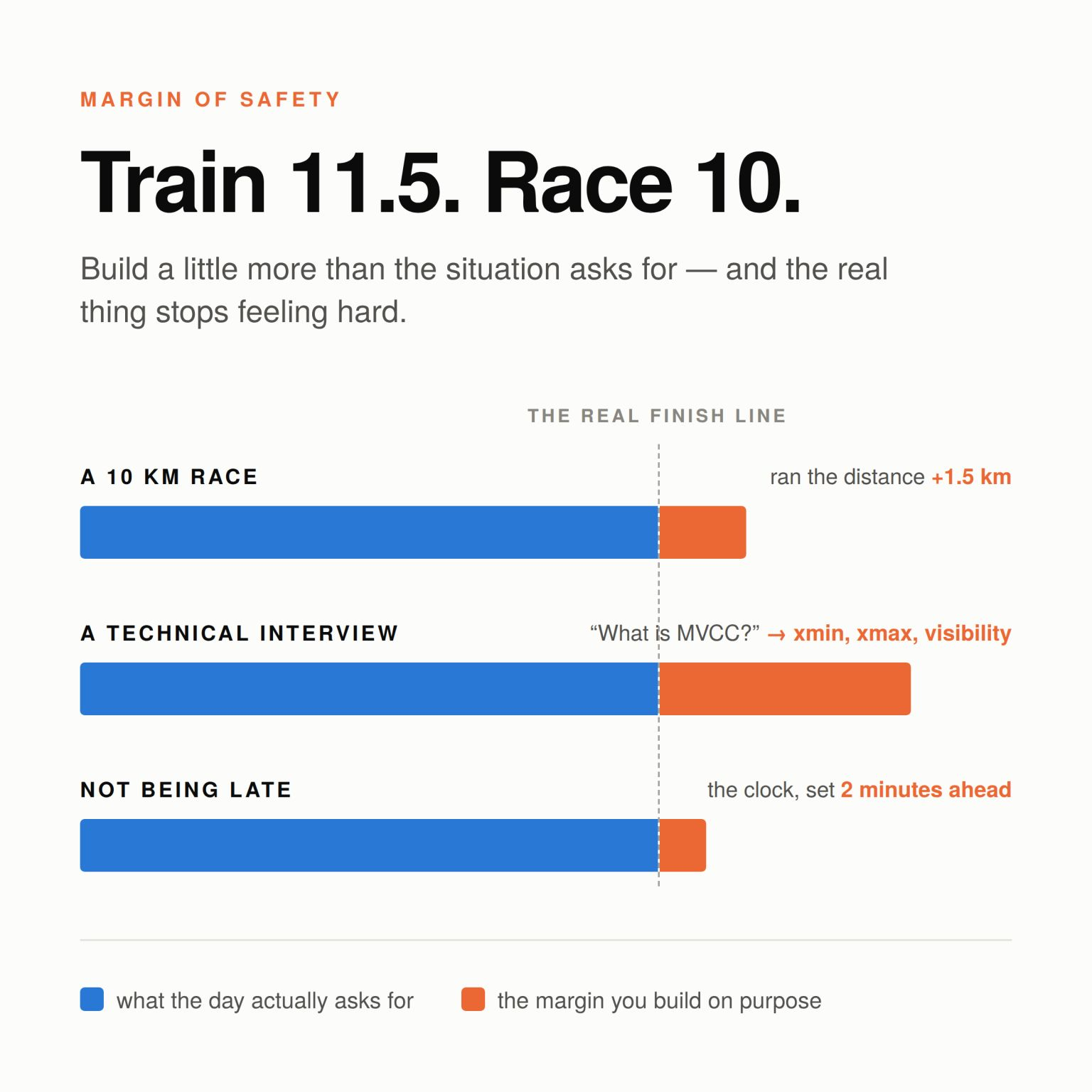
Today I was preparing for a 10 km race and finished the workout with a strange feeling. My watch showed that I had run slower than expected, and at first I was disappointed — I thought the training had gone badly.
Then I checked the route on the map and found that the watch had under-measured the distance by about 1.5 km. So instead of running 10 km badly, I had actually run around 11.5 km pretty well.
Engineers have a name for this: a margin of safety. You build the thing to hold more than it will ever be asked to hold. My watch had accidentally built one into my training.
While you’re preparing, the extra feels like overkill. Then you get to the actual race, and the real 10 km feels much easier because you have been training for 11.5.
The same principle shows up in small things everywhere:
- Preparing for a technical interview, it pays to go much deeper than you probably need. Not just “what is MVCC?”, but how PostgreSQL decides whether a tuple is visible, what
xminandxmaxmean, and so on. - You can set your clock two minutes ahead so you’re less likely to be late.
In all of these you deliberately build a margin into something small, so that the real thing feels easier.
What other analogies like this come to mind?